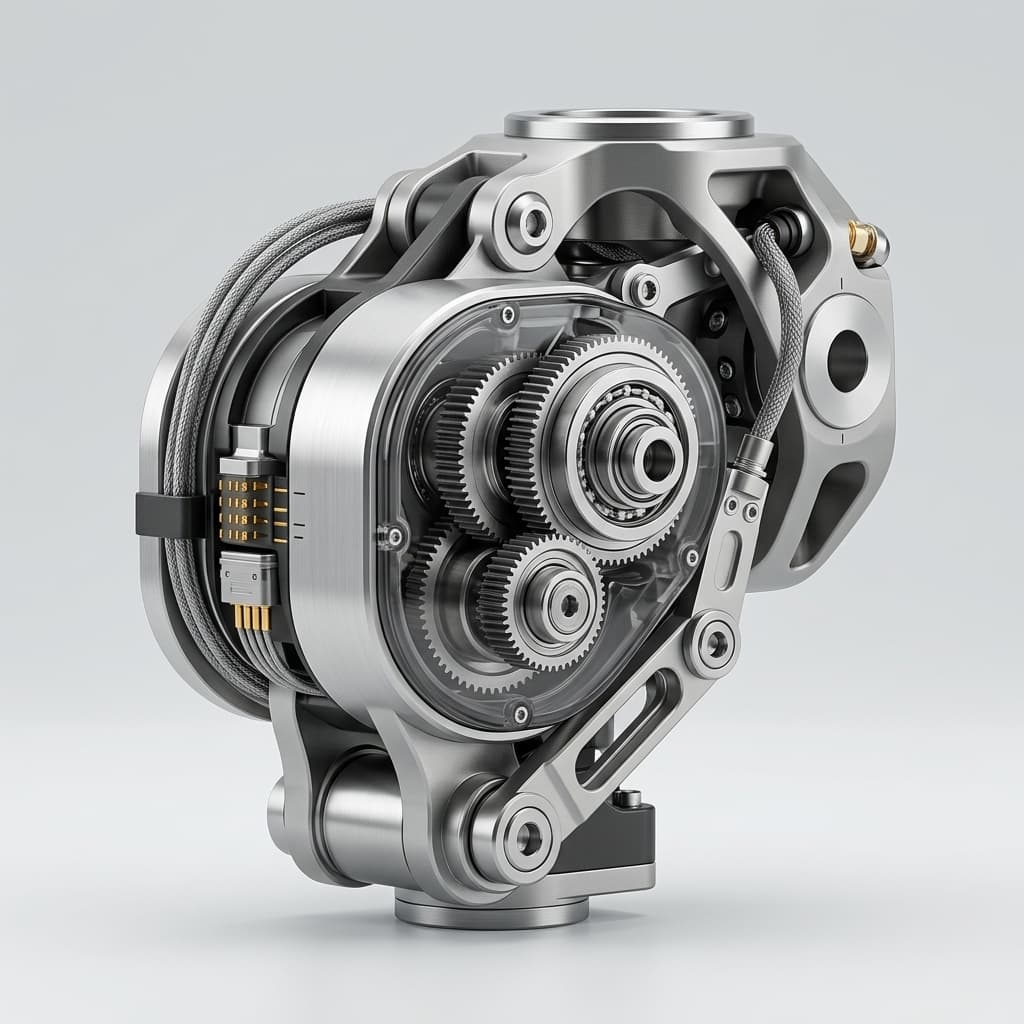
Humanoid Actuator Backlash Testing: RFQ Guide for Custom Reducers
How to evaluate reducer backlash claims for custom humanoid actuators, including preload, reversal method, assembled-joint testing, encoder location, and pilot-batch evidence.
Backlash numbers are easy to quote and hard to compare. A supplier can claim "less than 1 arcmin" in a catalog, but that number may come from a no-load, single-direction, reducer-only measurement. A humanoid joint cares about something stricter: how much lost motion appears after the reducer is assembled with the motor, bearing stack, housing, output flange, encoder, lubricant, preload, and real reversal torque.
For custom humanoid actuators, backlash testing should be treated as an RFQ requirement, not a post-sample complaint. The buyer should define the load condition, measurement method, direction reversal, temperature state, joint orientation, and evidence format before approving a reducer path.
Use this guide with the custom humanoid reducer architectures page and the harmonic vs. cycloidal drives guide. For pilot builds, align the evidence package with quality and engineering validation.
Scope note (published July 24, 2026): This guide is a buyer-side specification framework. Final acceptance criteria should be set by your actuator design owner, controller team, and supplier after reviewing the actual joint load, encoder topology, housing stiffness, and life-test target.
1. Why Catalog Backlash Claims Can Mislead Buyers
Backlash is usually described as angular lost motion at the output. In practice, the measured value changes with reducer type, preload, lubricant state, torque direction, fixture stiffness, bearing preload, housing tolerance, encoder location, and whether the measurement is taken before or after cycling.
For humanoid robots, this matters because different joints fail in different ways:
| Joint group | Why backlash matters | Common mistake |
|---|---|---|
| Ankles, knees, hips | Balance, foot placement, impact recovery, and post-shock joint play | Selecting a reducer from rated torque only, then discovering lost motion after gait cycles |
| Shoulders, elbows, wrists | Manipulation accuracy, smooth low-speed motion, and endpoint repeatability | Assuming a no-load gearbox value equals assembled arm performance |
| Neck and sensor joints | Vision stability, tracking smoothness, and low-noise motion | Ignoring hysteresis, friction, and micro-reversal behavior |
| Dexterous hands | Grip consistency, tendon control, and finger synchronization | Treating micro gearbox backlash as acceptable before testing under real grasp load |
A low published value is useful only when the test condition is visible. A more honest supplier may state a larger backlash value under defined load and full reversal. That evidence can be more valuable than a smaller number with no fixture, torque, or direction information.
2. Separate Backlash, Compliance, and Repeatability
Backlash is not the only motion error in a humanoid actuator. Before comparing suppliers, separate these terms in the RFQ.
| Term | What it describes | Why it should be separated |
|---|---|---|
| Backlash | Free angular lost motion when torque reverses | It affects direction changes, balance control, and precise positioning |
| Torsional compliance | Elastic twist under load | A joint can have low backlash but still deflect under high torque |
| Repeatability | Ability to return to the same position under the same approach direction | Good repeatability can hide poor reversal behavior |
| Hysteresis | Difference between loading and unloading paths | It affects force control, low-speed motion, and compensation models |
| Encoder-side error | Difference between motor-side and output-side feedback | Motor-side encoders can miss reducer lost motion unless paired with output feedback |
This separation is especially important for QDD or low-ratio designs. They may use dual encoders, lower reduction, and higher backdrivability. In those systems, the controller may compensate for some mechanical behavior, but only if the supplier and buyer know which error is backlash, which is compliance, and which is encoder placement.
3. Define the Test Condition Before You Believe the Number
Ask each supplier to attach test conditions to every backlash claim. A single line such as "backlash: less than 1 arcmin" should not be enough for pilot approval.
| Supplier claim | Missing condition | Better RFQ requirement |
|---|---|---|
| "Less than 1 arcmin" | Load, direction, fixture, and reducer state are unknown | State backlash under a defined reversal torque and assembled actuator fixture |
| "Zero backlash" | May refer to theoretical preload, not measured output behavior | Request measured lost motion, hysteresis curve, and preload condition |
| "Tested before shipment" | Test may be reducer-only rather than actuator-level | Request serial-level end-of-line data after actuator assembly |
| "Passed life test" | Cycle count, temperature, speed, and load may be missing | Request cycle profile, lubricant condition, post-cycle backlash, noise, and efficiency data |
| "Dual encoder compensation" | Mechanical lost motion may still affect impact and low-speed control | Request motor-side and output-side encoder logs during reversal |
A useful acceptance statement is specific. For example: "Measure output backlash after assembled actuator burn-in, using full direction reversal at 20 percent of rated torque, with fixture stiffness documented, output encoder data recorded, and the result mapped to serial number." The 20 percent load condition is not a universal rule. It is a practical example of a buyer-side requirement that makes suppliers state how the value was measured.
4. Recommended Backlash Test Package
For custom reducer or actuator RFQs, request a test package that includes both method and data.
| Evidence item | What to request | Why it matters |
|---|---|---|
| Test fixture | Fixture drawing, mounting boundary, output lever radius, and stiffness notes | Weak fixtures can exaggerate or hide lost motion |
| Load condition | Reversal torque, preload torque, applied load direction, and number of repetitions | No-load results rarely predict humanoid joint behavior |
| Sensor location | Motor-side encoder, output-side encoder, dial indicator, torque sensor, or external angle sensor | Measurement location changes the meaning of the result |
| Assembly state | Reducer-only, motor-reducer stack, or final actuator assembly | Housing tolerance and bearing preload can change backlash |
| Thermal state | Cold, warm, after burn-in, or after thermal-rise test | Lubricant and housing expansion can change lost motion |
| Data format | Raw CSV, plotted hysteresis loop, pass/fail summary, and serial mapping | Engineering teams need traceable data, not only a certificate |
| Post-cycle result | Backlash before and after load cycling, shock test, or burn-in | Some failures appear only after wear-in or impact |
This package does not need to be complex for every prototype sample. But the method should be agreed early so the buyer can compare sample A, sample B, and pilot units under the same condition.
5. Reducer Architecture Changes the Test Risk
Different reducer architectures need different attention points.
Harmonic or strain-wave reducers can deliver very low backlash in compact upper-body joints, but the buyer should verify torsional compliance, flexspline fatigue risk, post-shock behavior, lubrication condition, and whether any ratcheting or tooth skip appears after overload events.
Cycloidal reducers are often selected for higher shock tolerance and lower-body survivability. The buyer should check initial backlash, post-cycle backlash growth, pin and roller wear, lubrication stability, noise, vibration, and output bearing interaction.
Planetary reducers can be efficient and cost-effective, but backlash can be higher and harder to control in high-precision humanoid joints. If a planetary path is proposed, define whether the joint can tolerate lost motion or whether dual encoders and control compensation are required.
Custom hybrid stacks should be measured as complete assemblies. A reducer that performs well alone may behave differently after the motor, brake, encoder, crossed-roller bearing, housing, cable path, and output flange are integrated.
6. Joint-Level RFQ Guidance
Backlash targets should be tied to the joint function instead of copied across the full robot.
| Joint area | Primary concern | RFQ language to add |
|---|---|---|
| Lower-body joints | Balance, impact recovery, and post-shock joint play | Define backlash before and after cycling, plus shock-event assumptions and output bearing loads |
| Upper-body joints | Manipulation accuracy and low-speed smoothness | Define reversal behavior, noise, encoder topology, and endpoint repeatability |
| Wrist and hand joints | Fine positioning, compact packaging, and cable interaction | Define micro-reversal load, tendon or linkage load, and allowable grip error |
| Neck and sensor joints | Stable sensing and quiet tracking | Define low-speed hysteresis, acoustic target, and smooth reversal behavior |
If the robot controller can compensate for some lost motion, say so in the RFQ. But do not use software compensation as a substitute for mechanical evidence. A compensation model depends on stable and repeatable mechanical behavior. If backlash changes after heat, impact, or wear, the controller model also changes.
7. Pilot-Batch Evidence Before Approval
The key question before pilot production is repeatability. One good sample is not enough. The supplier should prove that the process can hold the chosen backlash condition across a small batch.
For pilot builds, request:
- Serial-numbered backlash results for every actuator or reducer.
- FAI and CMM records for housing datums, bearing seats, flange faces, and concentricity.
- Assembly torque records for fasteners and preload-sensitive components.
- Lubricant type, fill amount, and application method where relevant.
- Thermal-rise and burn-in records before final backlash measurement.
- Post-test noise, friction, efficiency, and joint-play notes.
- Nonconformance log and 8D response path for out-of-limit units.
This connects backlash testing to manufacturing control. A supplier who cannot measure the condition consistently cannot control it consistently.
8. RFQ Checklist for Backlash Transparency
Add these fields to the reducer section of your actuator RFQ:
- Reducer architecture preference: harmonic, cycloidal, planetary, linear, or supplier recommendation.
- Joint location and consequence of lost motion.
- Maximum allowable backlash and whether the value is reducer-only or assembled-actuator.
- Test torque, preload direction, reversal method, repetitions, and measurement speed.
- Measurement location: motor side, output side, external sensor, or fixture indicator.
- Encoder topology and whether output-side feedback is available.
- Housing, bearing, output flange, and lubrication conditions.
- Thermal state at measurement: cold, warm, after duty cycle, or after burn-in.
- Post-cycle and post-shock backlash acceptance criteria.
- Required evidence format: raw data, chart, report, serial mapping, and pass/fail rule.
If the supplier cannot provide all data in the first reply, ask them to mark assumptions clearly. A provisional quote is acceptable when the assumptions are visible. It is dangerous when the assumptions are hidden behind a small backlash number.
9. FAQ: Humanoid Actuator Backlash Testing
Q: Is less than 1 arcmin always better than less than 3 arcmin? No. A larger value measured under defined load, full reversal, and assembled-actuator conditions can be more useful than a smaller no-load catalog claim.
Q: Should backlash be tested before or after burn-in? Both can be useful. The buyer should know initial backlash and post-burn-in backlash because lubricant distribution, seating, wear-in, and temperature can change lost motion.
Q: Can dual encoders solve backlash? Dual encoders help the controller observe reducer behavior, but they do not remove mechanical lost motion, impact wear, lubricant issues, or housing stiffness problems.
Q: Should we test the reducer alone or the assembled actuator? Reducer-only testing is useful for incoming inspection. Pilot approval should also include assembled-actuator testing because housing tolerance, bearing preload, encoder placement, and output flange stiffness change the result.
10. Moving from Claim to Evidence
A humanoid actuator backlash claim is credible only when the test condition is visible. Before selecting a reducer path, send the joint map, torque-speed target, shock case, backlash target, encoder topology, housing boundary, and pilot quantity through the contact page. We can help convert the reducer question into a measurable actuator-level validation plan.
Categories
More Posts
Custom Humanoid Actuator BOM Integration and Sourcing Guide
How funded robotics teams can coordinate motors, reducers, encoders, drivers, bearings, housings, harnesses, validation evidence, and export logistics through one custom actuator ODM workflow.
How to Source Custom CNC Housings for Humanoid Actuators
An engineering breakdown of tolerances, material selection, GD&T, and machining costs when moving from benchtop prototype actuators to pilot-production precision CNC housings.
Standardized Evaluation Protocols for Humanoid Actuator Procurement
2026 procurement guide for custom humanoid actuator FAT/SAT protocols, dynamic-load tests, thermal derating, source evidence, and RFQ acceptance limits.