
QDD (Quasi-Direct Drive) Actuator Design for Bipedal Humanoid Legs
Overcoming impact shock and backdrivability constraints in bipedal robot legs using Quasi-Direct Drive (QDD) custom actuator architectures.
Bipedal locomotion is one of the most demanding applications in modern robotics. When a humanoid robot runs, jumps, or even walks across uneven terrain, the actuators in its hips, knees, and ankles are subjected to massive, unpredictable impact shocks.
Traditional high-ratio actuators (using harmonic drives or high-ratio cycloidal gearboxes, often >100:1) are excellent for slow, precise manipulation, but they suffer from high reflected inertia and poor backdrivability. When a rigid, high-ratio leg joint strikes the ground, the impact force cannot easily backdrive the motor. Instead, the kinetic energy is absorbed by the gear teeth, which can damage teeth or splines if the impact case is not designed for.
To solve this, advanced humanoid leg architectures—pioneered by labs like MIT (Cheetah/Mini Cheetah) and now scaled by commercial bipedal companies—rely on Quasi-Direct Drive (QDD) Actuators.
What is a QDD Actuator?
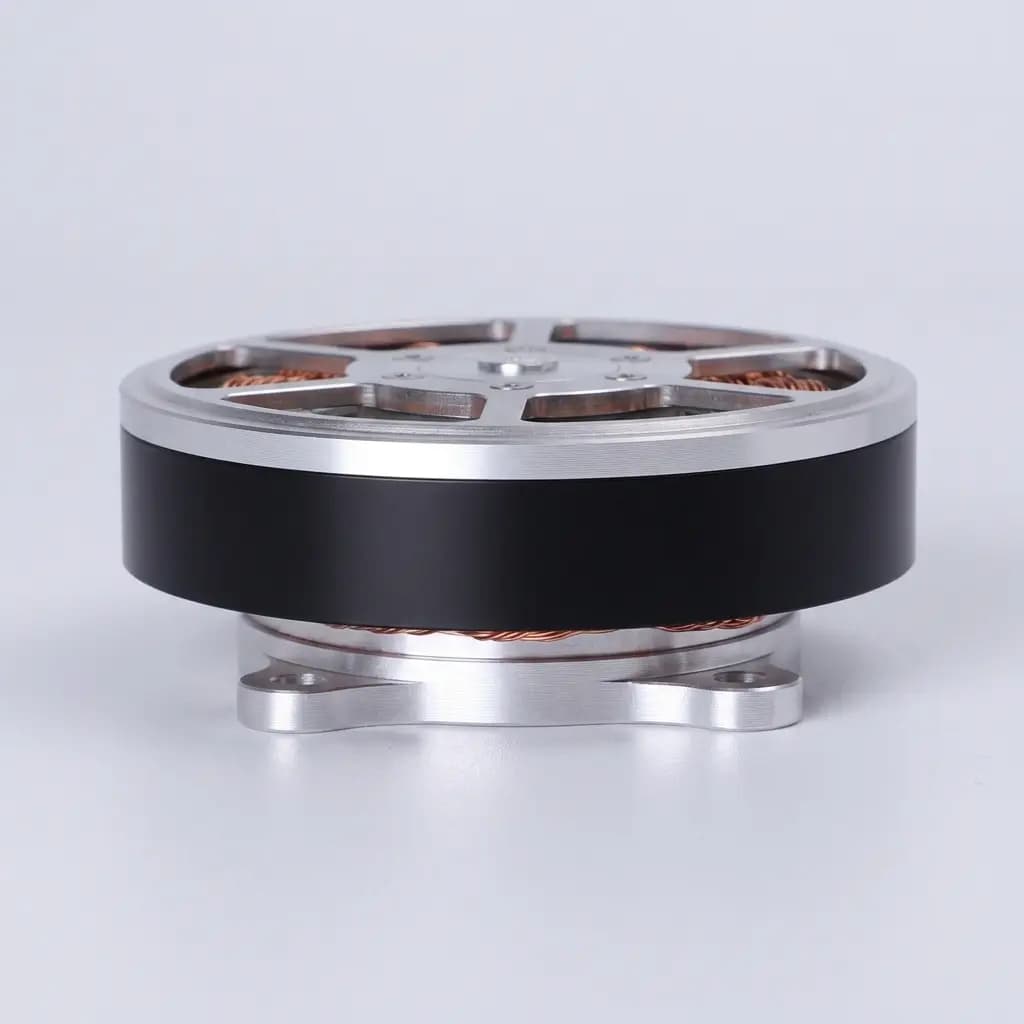
A custom QDD humanoid actuator pairs a high-torque, large-diameter frameless motor (often an outrunner/pancake topology) with a low-ratio planetary gearbox (typically between 6:1 and 10:1).
The Reflected Inertia Advantage
The resistance a joint feels when an external force tries to move it is heavily dictated by the motor's rotor inertia multiplied by the square of the gear ratio ($I_reflected = I_rotor \times N^2$).
- A 100:1 harmonic drive multiplies the motor's rotor inertia by 10,000.
- A 10:1 QDD planetary gear multiplies the rotor inertia by only 100.
Because the gear ratio is so low, the mechanical advantage works symmetrically in both directions. The motor can drive the joint efficiently, and external forces on the joint can easily backdrive the motor. This high backdrivability allows the robot's control system to perform highly responsive proprioceptive force control.
Handling Impact Shock with Software-Defined Compliance
In a QDD leg joint, when the foot strikes the ground, the impact shock travels up the leg structure, passes through the low-ratio planetary gearset without stripping the robust, large-module sun and planet gears, and instantly backdrives the rotor.
The motor controller can sense this back-EMF or current spike quickly enough to support active current modulation when the electronics and control loop are designed for it. The controller then uses the motor's electromagnetic field as a virtual, programmable spring and damper. The resulting QDD actuator can provide bipedal robots with the speed needed for dynamic running and the software-defined compliance needed to reduce impact risk, making it a common architecture candidate for lower limbs in modern humanoid platforms.
Start Your Custom Actuator ODM Project
If you have a frozen joint CAD and a 3D torque-speed matrix, our engineering team targets DFM (Design for Manufacturing) intake within one business day when the dataset is complete. Upload your CAD and Submit an RFQ →
The Engineering Challenges of Custom QDD Legs
While QDD is conceptually elegant, executing it within the strict size and weight constraints of a dense bipedal leg requires rigorous ODM engineering:
- Massive Continuous Torque Density: Because the gear ratio is low (e.g., 9:1), the motor itself must generate a tremendous amount of raw torque to support the robot's weight. This requires highly optimized electromagnetic designs: large air-gap radii ($Torque \propto Radius^2$), tightly packed copper windings (high slot fill factor), and exceptional Halbach array magnet configurations.
- Thermal Management (The Squatting Problem): Squatting or holding a bent-knee stance forces the QDD motor to draw high continuous current (producing heavy $I^2R$ copper losses) just to fight gravity. An FEA thermal engineering review is usually part of serious review. The custom actuator housing should be designed to pull heat directly from the stator laminations into the outer chassis to reduce overheating risk under the agreed duty cycle.
- Planetary Gearbox Backlash vs. Efficiency: Low-ratio planetary gears are durable but naturally suffer from higher backlash (often 3-10 arcmin) than harmonic drives (zero backlash). For a bipedal leg custom joint, the sun, planet, and ring gears must be precision-machined (often helical rather than spur gears) to minimize acoustic noise and deadband while maintaining the >90% efficiency required for true backdrivability.
Prototyping QDD Actuators for Bipedal Programs
If you are developing a new bipedal platform, off-the-shelf QDD modules (often designed for robotic dogs) rarely fit the exact structural envelope or carry the thermal mass required for human-scale bipeds. You need the motor, gearbox, dual absolute encoders, and driver packaged directly into the structural links of your specific robot.
Partnering with an experienced humanoid actuator ODM allows you to define the exact outer diameter, axial length, cable routing path, and mounting flanges required for your kinematics. By working from low-ratio planetary architectures and high-torque-density frameless motor options, you can reduce avoidable iteration before pilot builds.
QDD Leg Actuator Selection Matrix
QDD is not automatically the best answer for every humanoid joint. It is most useful when backdrivability, dynamic control, and impact survival matter more than holding position with minimum current.
| Decision Area | QDD Is Usually a Strong Fit When | Use More Caution When | RFQ Evidence to Request |
|---|---|---|---|
| Hip and knee drive ratio | The robot needs running, recovery steps, or compliant walking on uneven ground. | The joint mainly holds static posture and has limited cooling path. | Torque-speed curve, continuous current limit, thermal-rise test method, and overload duration. |
| Ankle packaging | The design needs fast response, low reflected inertia, and ground-contact compliance. | The available axial length cannot support bearings, encoder, reducer, and cable exit. | Section CAD review, bearing load check, cable keep-out zones, and assembly access notes. |
| Control architecture | The team can tune current, velocity, impedance, and safety behavior in software. | The actuator must behave like a rigid positioning module with little control-team bandwidth. | Driver interface, encoder resolution, current loop bandwidth, brake state, and fault behavior. |
| Pilot production | The platform has a clear joint map and can freeze CTQs before pilot build. | Each robot revision changes the actuator envelope or load case. | Drawing revision, BOM revision, CTQ list, outgoing inspection records, and sample acceptance report. |
The practical takeaway: select QDD for humanoid legs when the full system can use its compliance. If the controller, thermal path, or mechanical envelope is not ready, a low-ratio actuator can expose weaknesses faster than a high-ratio module.
RFQ Inputs for a Bipedal QDD Joint
A useful QDD quote needs more than a peak torque target. Before asking for prototype pricing, prepare these inputs:
| Input | Why It Matters |
|---|---|
| Robot mass, payload, and joint position | Separates hip, knee, and ankle sizing instead of treating the leg as one generic actuator. |
| Continuous, peak, and overload torque conditions | Prevents suppliers from quoting a motor that survives a bench test but overheats in squat or recovery motion. |
| Speed, backdrivability, and impact assumptions | Defines whether the actuator is being optimized for dynamic gait, compliance, or slow positioning. |
| CAD envelope, forbidden zones, and cable exit | Confirms the reducer, encoder, bearings, driver, and harness can be assembled and inspected. |
| Brake and power-off behavior | Prevents late redesign when the robot needs holding torque, safe fall behavior, or service positioning. |
| Validation plan | Aligns thermal, backlash, noise, torque-speed, burn-in, and outgoing inspection records before pilot orders. |
For lower-body programs, connect this RFQ package with the bipedal leg custom joint workflow and the quality validation evidence plan before releasing sample purchase orders.
QDD vs. High-Ratio Transmission: Decision Matrix
The choice between QDD and traditional high-ratio transmissions (harmonic, cycloidal, planetary) is not binary. Different joints on the same robot often require different drive architectures. This matrix helps buyers map each joint to the right transmission type based on operational requirements.
| Parameter | QDD (Ratio 1:4 to 1:10) | Harmonic Drive (1:50 to 1:160) | Cycloidal (1:30 to 1:120) | Planetary (1:3 to 1:100) |
|---|---|---|---|---|
| Backdrivability | Excellent: reflected inertia is low, joint moves freely when unpowered | Poor: high friction and gear mesh prevent passive motion | Poor to moderate: depends on stage count and lubrication | Moderate: better than harmonic, worse than QDD |
| Impact tolerance | Excellent: low-ratio gearing absorbs shock through motor compliance | Poor: shock loads directly stress the wave generator and flex spline | Good: rolling contact distributes impact across multiple pins | Moderate: planet gears can survive moderate shock if bearings are sized |
| Torque density | Moderate: large motor required to compensate for low gear ratio | Excellent: high ratio multiplies small motor torque efficiently | Very good: competitive with harmonic at lower ratios | Good: multi-stage designs can achieve high ratios in compact packages |
| Backlash | Moderate: 0.1-0.5° typical at output | Excellent: near-zero backlash (under 1 arcmin) | Good: 1-3 arcmin typical | Poor: 5-15 arcmin typical, worsens with wear |
| Thermal load on motor | High: motor does most of the torque work | Low: gear ratio amplifies torque, motor runs cooler | Low: similar benefit to harmonic | Moderate: depends on ratio and efficiency |
| Noise | Low: minimal gear mesh noise | Low: smooth wave-gear engagement | Moderate: pin engagement can produce hum at specific speeds | High: gear mesh noise scales with speed |
| Cost per joint | High: requires large, expensive frameless motor | High: harmonic drive components are expensive | Moderate: less expensive than harmonic at equivalent ratios | Low: most cost-effective high-ratio option |
| Best humanoid application | Dynamic leg joints, compliant arm joints, any joint requiring fall recovery | Precision wrist, neck, and finger joints requiring positioning accuracy | Hip and shoulder joints needing balance of torque and impact tolerance | Low-cost demonstration prototypes, joints with relaxed backlash requirements |
Key takeaway: Most successful bipedal humanoid robots use QDD for knee and ankle joints (where impact compliance and backdrivability are critical for stable walking) and harmonic or cycloidal drives for hip roll/yaw joints (where holding torque and compact packaging take priority over compliance). The optimal architecture is almost always a hybrid, not a single transmission type across all joints.
Application Scenario Decision Tree
Use these five scenarios to quickly match your joint requirements to the right actuator architecture:
-
Dynamic walking knee joint (high-impact, high-speed): Use QDD. The knee experiences the highest impact loads during heel strike and the fastest angular velocities during swing phase. Backdrivability is essential for natural gait compliance and fall recovery. Pair with a custom QDD actuator designed for your specific robot mass and gait cycle.
-
Hip pitch joint (high-torque, moderate speed): Consider cycloidal or QDD depending on the robot's mass. Robots under 40 kg can use QDD at the hip; robots over 60 kg typically need the torque multiplication of a cycloidal or harmonic drive to keep motor size manageable.
-
Ankle pitch/roll joint (impact-critical, compact): QDD preferred if envelope permits. The ankle experiences the second-highest impact loads after the knee and must absorb landing energy. If the ankle envelope is too small for a QDD motor, consider a compact arm actuator architecture with a low-ratio planetary stage.
-
Shoulder and elbow joints (moderate load, cable routing): These joints benefit from frameless hollow-shaft architectures regardless of transmission type. QDD is suitable for arms that must be compliant during human interaction; harmonic drives suit arms optimized for precision manipulation.
-
Wrist and hand joints (low torque, high precision): High-ratio harmonic or planetary drives are typically preferred. Dexterous hand micro actuators need minimal backlash and high positional accuracy more than they need backdrivability.
QDD Leg Actuator FAQ
Can QDD replace harmonic drives in every humanoid leg joint?
No. QDD is strongest where dynamic motion and impact compliance matter. High-ratio harmonic or cycloidal designs can still be appropriate for compact joints that need high holding torque, low backlash, and limited backdrivability.
What is the biggest prototype risk for QDD legs?
Thermal mismatch is usually the first risk. A low-ratio design shifts more torque work onto the motor, so the housing, stator contact, duty cycle, driver heat, and robot-side heat path must be reviewed together.
What should be checked before moving from QDD sample to pilot batch?
Freeze the drawing revision, BOM revision, CTQ dimensions, torque-speed acceptance method, thermal-rise condition, backlash limit, brake behavior, cable routing, and outgoing report package. Without those controls, a pilot batch becomes another uncontrolled prototype run.
Categories
More Posts
Frameless vs. Framed Motors in Humanoid Robot Joints: A Packaging and Thermal Analysis
An in-depth engineering analysis on why advanced humanoid robot teams migrate from framed servomotors to frameless torque motors for custom joint actuators to optimize space, weight, and thermal dissipation.
Custom Humanoid Actuator ODM RFQ Guide
How to prepare a serious custom humanoid actuator RFQ with CAD, torque-speed targets, thermal assumptions, interfaces, and pilot-build expectations.
Humanoid Actuator Backlash Testing: RFQ Guide for Custom Reducers
How to evaluate reducer backlash claims for custom humanoid actuators, including preload, reversal method, assembled-joint testing, encoder location, and pilot-batch evidence.